French Press vs Espresso: Caffeine Content & Extraction Science
We break down the extraction kinetics, brew ratios, and particle physics that dictate exactly how much caffeine ends up in your cup.
This article contains affiliate links to products we have independently tested and vetted.
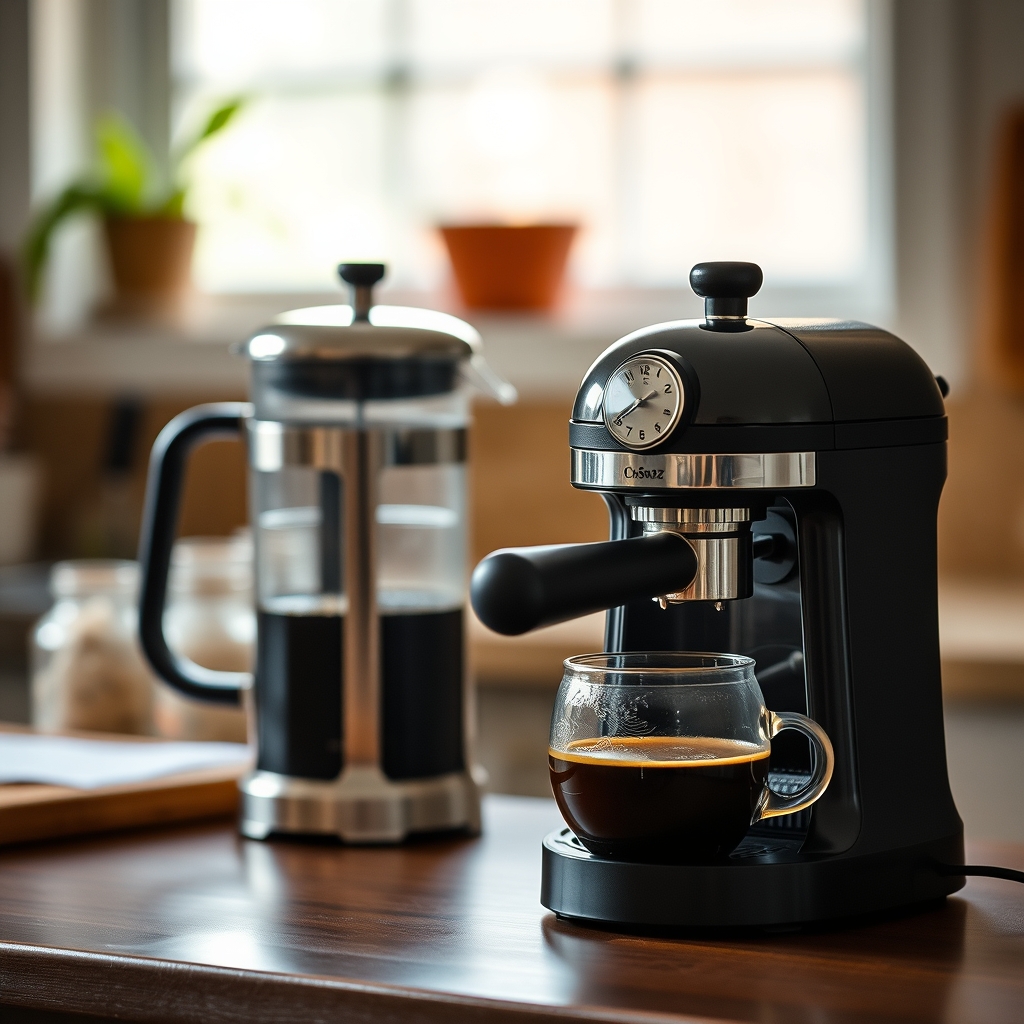
The Science of Caffeine Extraction: Why Method Matters
When comparing the caffeine output of different brewing methods, it is easy to get lost in anecdotal claims. However, at our independent lab, we focus on the physics of solute release. Understanding the differences in brewing philosophy between a French Press and an espresso machine is essential to demystifying why one might feel 'stronger' than the other. Caffeine is a highly soluble alkaloid, meaning it extracts early and efficiently in almost any brewing environment, but the efficiency of that extraction is governed by thermal energy, agitation, and contact time.
Immersion vs. Pressure: Understanding the Mechanics
The French Press utilizes an immersion brewing technique. Here, coffee grounds remain in direct contact with the water for the duration of the brew cycle—usually 4 to 5 minutes. This creates a steady-state equilibrium where caffeine leaches out into the water until the solvent is saturated or the contact time ends. Conversely, espresso relies on pressure-based extraction. By forcing water through a tightly packed puck of finely ground coffee at 9 bars of pressure, the machine accelerates the extraction process. This high-pressure environment forces solutes out of the coffee matrix much faster than passive immersion, resulting in a highly concentrated liquid. See also our guide on Best Budget Espresso Machines 2026.
The Role of Surface Area and Grind Size
The extraction of caffeine and other compounds like chlorogenic acids is fundamentally a mass transfer process. The efficiency of this transfer is dictated by the particle size distribution (PSD) of your grind. In a French Press, we utilize a coarse grind to prevent over-extraction and sediment buildup. Because these larger particles have a lower surface-area-to-volume ratio, the water takes longer to reach the center of each coffee shard. Espresso, however, demands a fine, uniform grind. This massive increase in total surface area allows the high-pressure water to strip caffeine from the cellular matrix almost instantaneously. If your grinder produces inconsistent fines, you risk 'channeling' in espresso, where water finds the path of least resistance, leading to an uneven extraction that leaves caffeine trapped in the larger, under-extracted particles. See also our guide on Best Budget Espresso Machines 2026.
French Press: The Long-Form Extraction Approach
How Immersion Affects Caffeine Saturation
In a French Press, the large volume of water relative to the coffee grounds ensures that the solvent does not become overly saturated with solutes, allowing for a more complete extraction of caffeine over a longer period. While the first two minutes of brewing capture the majority of the caffeine, the extended contact time ensures that even the most difficult-to-reach compounds are liberated from the coarse grounds. Because there is no external pressure, the extraction is gentler, relying on thermal diffusion and the concentration gradient to move caffeine from the coffee cell wall into the water. See also our guide on Best Budget Espresso Machines 2026.
Typical Caffeine Yields in a Standard French Press Cup
A standard 8oz cup of French Press coffee typically contains between 80mg and 120mg of caffeine, depending on the coffee-to-water ratio. Because the total volume is high, the total caffeine dose per serving is generally greater than a single shot of espresso. This makes the French Press a 'slow-release' caffeine delivery system, as the total volume consumed spreads the intake over several minutes.
Espresso: The High-Pressure Catalyst
When using an espresso machine, achieving consistent pressure for extraction is the primary challenge. High pressure changes the physical state of the water and its interaction with the coffee oils and solids. This pressure forces the water into the gaps between the tightly compacted grounds, stripping caffeine and other compounds with extreme efficiency.
Why Espresso Packs More Punch Per Ounce
Espresso is defined by its extreme concentration. A single 1oz shot typically contains 60mg to 75mg of caffeine. If you were to scale this to an 8oz serving, you would be consuming upwards of 400mg of caffeine. This density is the hallmark of espresso brewing. The high pressure (9 bars) creates an emulsion of coffee oils and gases, which acts as a carrier for the concentrated caffeine. This is why a single shot provides such an immediate, visceral impact—it is not necessarily that the machine is 'more efficient' at extracting total caffeine, but rather that it is significantly more efficient at concentrating that caffeine into a tiny volume.
Variables Influencing Espresso Caffeine Concentration
Beyond pressure, the temperature of the water and the roast level of the beans play a massive role. Lighter roasts are denser and often require higher temperatures to fully extract, while darker roasts are more brittle and porous. If your machine's temperature is unstable, your caffeine yield will fluctuate. Furthermore, the dose—the amount of dry coffee used—is the ultimate lever. A double basket containing 18-20g of coffee will produce nearly double the caffeine of a single shot, even if the extraction time remains constant.
Caffeine: Concentration vs. Total Dose
| Model | Metric | Concentration (mg/oz) | Typical Serving Size | Total Caffeine (per serving) | Price | Buy |
|---|---|---|---|---|---|---|
| French Press | ~12-15mg/oz | 8oz | 90-120mg | Versatile | ||
| Espresso | ~60-75mg/oz | 1oz | 60-75mg | Concentrated |
Direct Comparison: Concentration vs. Total Dose
Analyzing the 'Per Ounce' vs. 'Per Serving' Myth
A common misconception is that espresso is 'caffeinated' differently than coffee. In reality, caffeine is caffeine. The difference lies entirely in the brew ratio. Coffee is typically brewed at a 1:15 or 1:17 ratio of coffee to water. Espresso is brewed at a 1:2 or 1:3 ratio. Because you are using significantly less water to extract the coffee, the resulting liquid is naturally more concentrated. If you were to dilute an espresso shot with water (making an Americano), you would have the exact same caffeine content as the shot, just in a larger, less concentrated volume.
Controlling Your Caffeine Intake Through Brew Ratios
To control your intake, focus on the weight of your dry coffee grounds. If you find yourself getting over-stimulated, reduce your dose by 1-2 grams. In French Press, this is easy to measure with a scale. In espresso, this requires adjusting the basket load. By manipulating the dose rather than the time or pressure, you maintain flavor consistency while strictly managing your caffeine consumption.
Practical Implications for Your Daily Routine
Choosing Your Machine Based on Caffeine Needs
If you are looking for a sustained caffeine boost throughout the morning, the higher total dose of a French Press is often more effective. However, if you require an immediate, high-concentration hit, espresso is the superior tool. When evaluating espresso machine performance, remember that the grind consistency is just as important as the pressure itself. Without a uniform grind, you will experience uneven extraction, leading to a bitter cup that lacks the expected caffeine delivery.
Failure Modes and Troubleshooting Your Extraction
Over-extraction and Under-extraction Effects on Caffeine
Under-extraction occurs when water fails to pull enough solubles, often resulting in a sour, watery cup. While caffeine extracts very early in the process, under-extraction still results in lower overall caffeine yield because the water didn't have enough contact or pressure to fully permeate the grounds. Over-extraction, conversely, pulls bitter, astringent compounds that can mask the caffeine's stimulating perception. In a French Press, this is usually caused by too much time or too fine a grind; in espresso, it is caused by too high a temperature or too slow a shot time (choking the machine).
How to Adjust Your Grinder for Consistent Caffeine Levels
The consistency of your grinder is the single biggest factor in the repeatability of your caffeine dose. If your grinder produces 'boulders' (large chunks) and 'fines' (dust), the water will extract caffeine unevenly. For consistent caffeine levels, invest in a burr grinder that offers high alignment. A high-quality grinder ensures that every particle is the same size, meaning the water extracts the same amount of caffeine from every gram of coffee, every single time.
Conclusion: Balancing Taste and Stimulation
Ultimately, the choice between French Press and espresso is a balance between your lifestyle needs and your sensory preferences. The French Press offers a full-bodied, long-form drinking experience with a higher total caffeine load, while espresso provides a high-intensity, concentrated hit that serves as the foundation for most specialty coffee drinks. By understanding the physics of your brewing equipment, you can tune your routine to ensure you get exactly the amount of caffeine you need, without sacrificing the flavor profile you love.
Frequently Asked Questions
Yes, in terms of total caffeine per serving. An 8oz cup of French Press generally contains more total caffeine (80-120mg) than a single 1oz espresso shot (60-75mg).
Espresso has a higher concentration of dissolved solids per ounce. The intense flavor profile is a result of emulsified oils and high TDS (Total Dissolved Solids) rather than the caffeine content alone.
Finer grinds increase the surface area contact with water, leading to faster extraction. However, in a French Press, too fine a grind can lead to over-extraction, bitterness, and sludge in your cup.
You can use a lower dose of coffee grounds in your portafilter or switch to a decaffeinated blend, but adjusting the machine's pressure will primarily affect flavor and texture rather than caffeine levels.
Related guides on this site
These pages sit in the same topical map — go deeper without leaving the cluster:
- Best Budget Espresso Machines 2026
- Best Budget Espresso Machines 2026: Hands-On Reviews & Buyer's Guide
- Best Coffee Grinders for French Press vs Espresso: A Comprehensive Buying Guide
- Espresso Machine Maintenance vs French Press Cleaning: A Comprehensive Guide
- French Press Techniques for Espresso-Like Strength: A Scientific Guide
- French Press vs Espresso: Which Brewing Method Suits You?
- Top Manual Espresso Makers for French Press Lovers: An Extensive Review
Related guides
Espresso Machines
Best Budget Espresso Machines 2026: Hands-On Reviews & Technical Guide
We tested budget espresso machines under $500 for thermal stability, pressure regulation, and shot quality. Discover top entry-level models that deliver true espresso.
Read guide →Coffee Equipment
Best Coffee Grinders for French Press vs Espresso: A Comprehensive Buying Guide
Stop guessing your grind size. Learn how to navigate the technical divide between French Press and espresso with our data-driven grinder buying guide.
Read guide →Coffee Education
Espresso Machine Maintenance vs French Press Cleaning Guide
Comprehensive engineering and hygiene guide comparing espresso machine mechanical maintenance against French press deep cleaning routines.
Read guide →Coffee Science & Equipment
Espresso Machine Pressure Profiles: 9 Bars vs. Variable Pressure
An in-depth fluid dynamics and extraction study comparing fixed 9-bar espresso extraction with variable pressure profiling for optimizing yield, body, and flavor.
Read guide →